ScottishPower: Reinventing Fault Studies for Modern Grids
Rebuilding the Math of Short-Circuit Analysis for a Renewable-Dominated Power System
June 11, 2026
For most of the last century, the question of what happens when a power grid faults has had a settled answer. Big rotating generators set the dynamics, and predictable physics governed the response. A calculation codified in the IEC 60909 standard gave engineers across the world a fast, transparent way to design protection systems and size equipment. The math worked because the grid the math described stayed roughly the same.
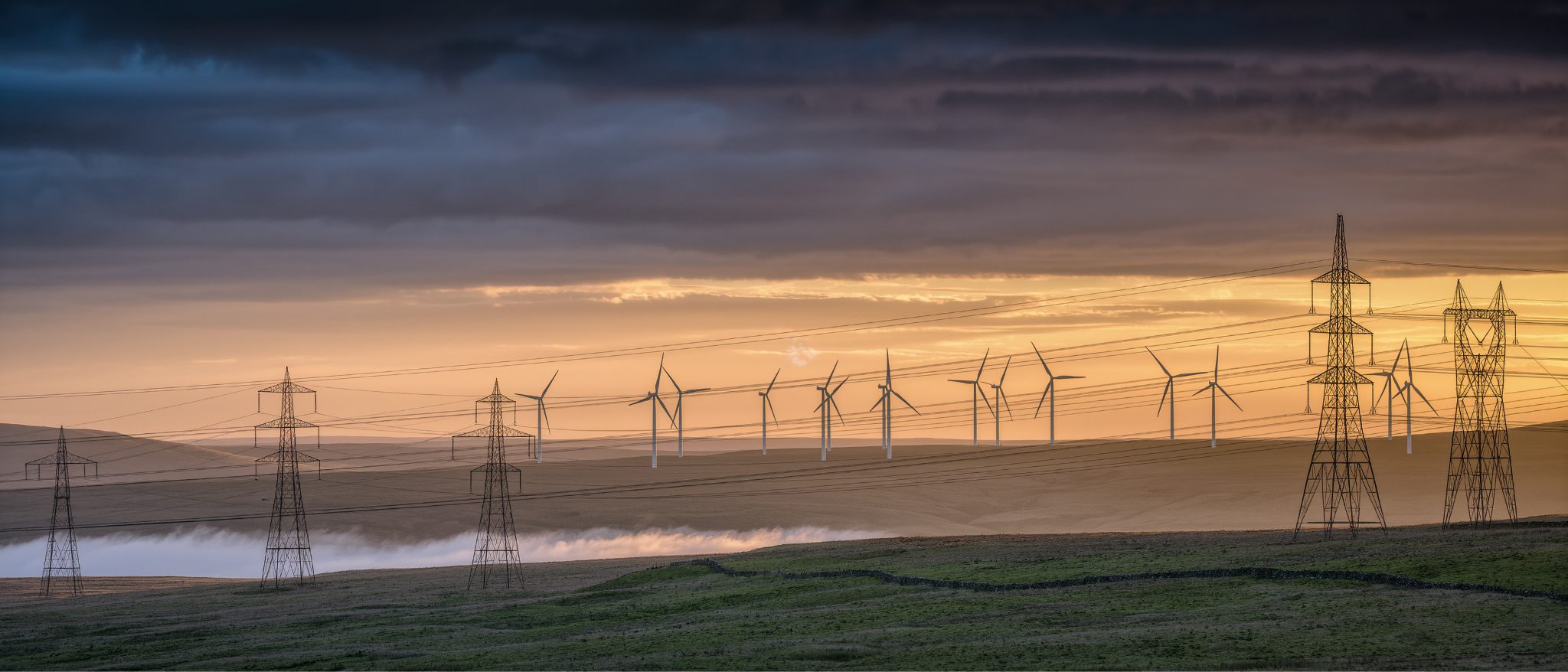
However, that grid is no longer the grid we operate. In central and southern Scotland, where ScottishPower Energy Networks runs the corridor that carries renewable energy from Scottish wind farms into homes across England and Wales, the picture has been changing for years. Synchronous generators are retiring, and wind farms, battery storage and HVDC interconnections are taking their place. These devices are no longer governed only by the inertia of spinning metal. Their fault response depends on software, on the control logic written into power-electronic converters that decide, millisecond by millisecond, what voltage they should synthesize. The physics of a fault has started to depend on how each device is programmed.
A Method Built for a Different Grid
The IEC 60909 standard was a triumph of practical engineering. It distilled the behaviour of a synchronous grid into a calculation any planner could perform with limited data and limited compute. For decades it has been the backbone of fault studies across the industry, and for many parts of many networks it still works exactly as intended.
The trouble is what the standard assumes. It computes fault levels using an equivalent voltage source at the fault location, without explicitly representing the conditions that existed the moment before the fault. It neglects elements that no longer can be neglected, such as non-rotating loads and various shunt components. Most importantly, it represents converters through a simplified prescribed current injection, without solving what those converters are actually doing.
In a grid where converters supply a small share of the fault current, that simplification is harmless. In a grid where they dominate, it can produce numbers that sit visibly apart from how the system responds in real time. The grid ScottishPower operates today already lives close to that boundary. The grid it will operate in five years will be well past it.
The Honest Alternative, and Its Limits
The other option has always been dynamic simulations. Tools like DIgSILENT PowerFactory can model every converter's control system in full detail and capture the millisecond-by-millisecond evolution of a fault. The accuracy is exquisite, but the cost is high. Each study takes time, demands exhaustive models for every device on the network, and cannot scale to the thousands of operating conditions modern planning requires.
A planning engineer who needs to test every credible fault on every credible day of the year quickly hits a wall. So does a protection engineer designing settings that must hold under tens of thousands of system configurations. The result, across the industry, is a quiet compromise: use the classical method where it stretches, use the dynamic simulation only where you must, and accept that some scenarios will never be studied at all.
That compromise is the one ScottishPower, eRoots and CITCEA-UPC set out to dissolve.
Asking the Converter What It Would Do
The idea behind the new method is simple to describe and harder to execute. Keep the speed and transparency of a steady-state calculation. Add the one piece classical methods have always missed: the control logic that determines how modern equipment actually behaves when faults occur.
The calculation begins from the grid's real operating state, a normal power flow that captures the voltage profile the moment before a fault. The fault is then imposed, and the calculation does something the classical method never did. It asks each converter what its control system would output under the new conditions, recalculates the nodal balance, then asks again, looping until every device and every node settles into a consistent steady state. The dynamic transients fall away, the oscillations strip out, and what remains is the same final answer a full dynamic simulation would reach.
The team used the internationally recognised WECC Type 4 wind turbine as the first reference model. Its full control diagram, complete with current limits, voltage-dip logic, reference tracking and protection blocks, was rebuilt in steady-state form inside VeraGrid. The result is a converter representation that respects the physics, while remaining fast enough to solve thousands of scenarios in the time a single dynamic simulation would take.
What the Validation Shows
The team validated the approach on the models the industry already trusts. A small four-bus case first, where the dynamics could be inspected in detail. Then the IEEE 14-bus benchmark, extended with multiple converter-interfaced sources to mirror the renewable mix of a modern transmission system. Finally, the team worked up to larger cases, including a simulation of the full ScottishPower network model of more than 1000 buses imported directly from PowerFactory into VeraGrid.
The result that tells the story most clearly is the figure below. The blue line traces the dynamic response in PowerFactory. The green dashed line is the VeraGrid steady-state result. The two converge exactly. The red dashed line, the IEC 60909 estimate, sits clearly apart from both.
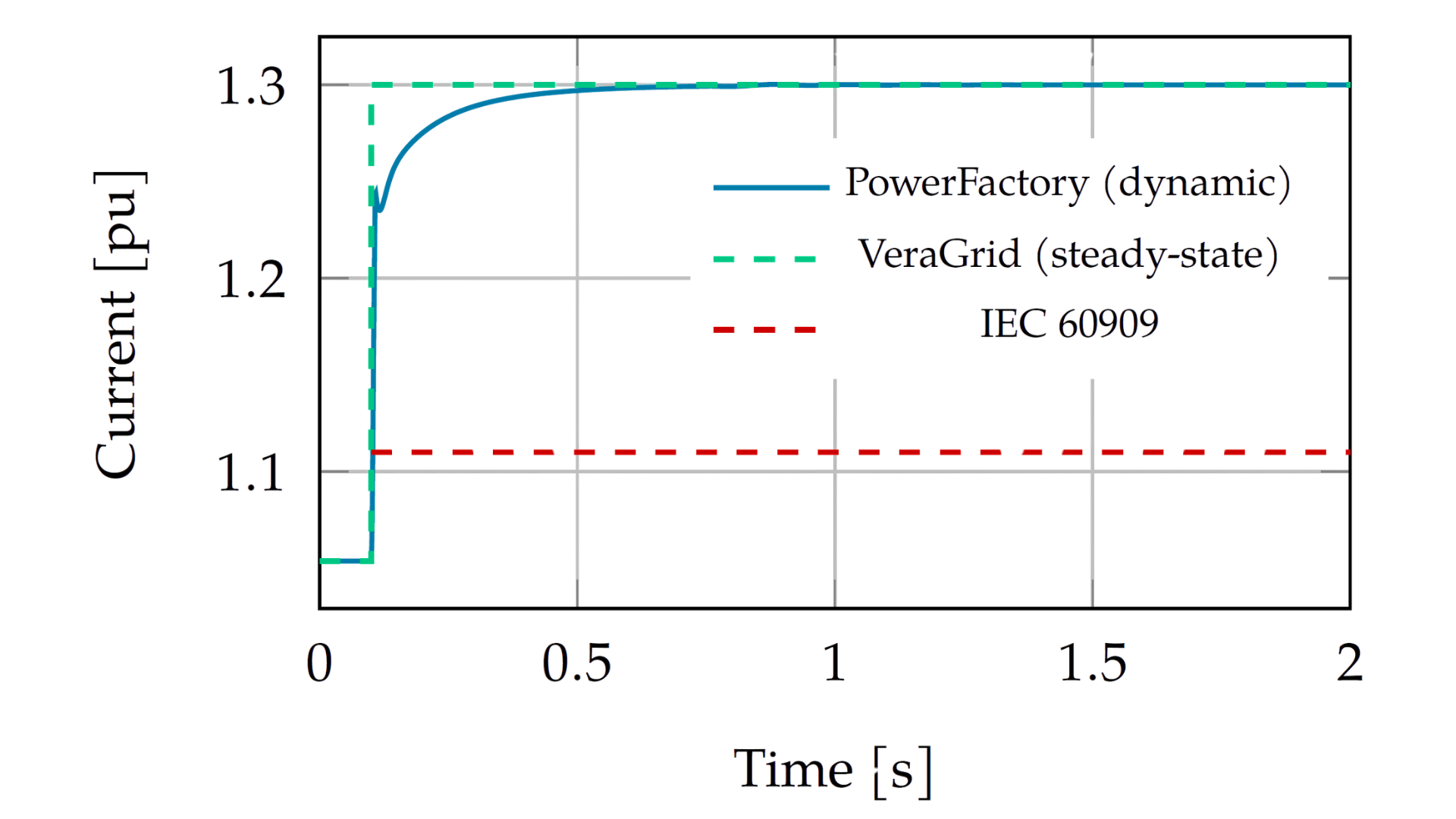
Across the validated cases, the new method reproduces the dynamic steady-state fault current with typical error below 1%, while running on the order of a thousand times faster than a full dynamic study and relying on significantly less model data.
Those are the engineering headlines. The deeper story is qualitative. Studies that were too expensive to repeat at scale become routine. A protection engineer can sweep thousands of operating conditions across a year of grid evolution. A planner can stress-test a new wind farm connection against every credible system configuration. Work that used to be reserved for the most important cases becomes feasible for the most numerous ones.
Why This Matters Beyond Scotland
For ScottishPower, the impact is concrete. The network they operate is going to keep changing. Every new wind farm, every new HVDC link, every new battery connection adds another operating condition that needs to be tested, and another protection setting that needs to be validated. A method that delivers full-simulation accuracy at thousands of scenarios per study makes that work tractable for the first time.
The implication runs further. Every transmission system operator preparing for the energy transition faces the same arithmetic. The number of credible fault scenarios is growing faster than the time available to study them. The fidelity required is rising as power electronics replace rotating machines. The tools that scaled with the old grid will not scale with the new one. Closing that gap is the unglamorous, essential work of making the transition operable.
What Comes Next
The collaboration between ScottishPower, eRoots and CITCEA-UPC will not stop here. The next phase of the Industrial PhD is already underway, extending the method to the asymmetrical, single-phase faults that dominate real-world disturbances on distribution networks, with the IEEE 13-node feeder as the first benchmark.
Each step keeps the same principles visible. The code is open. Every algorithm can be inspected. The methodology is built shoulder to shoulder with the engineers who plan and operate the grid. What gets built in this work is a faster calculation and a way of performing fault studies that scales, giving planners the confidence to study more scenarios, more often, while preserving the trust that decades of standard methods have earned.
Modern power systems will be assessed based on their robustness. Behind that simple measure lies an enormous amount of careful engineering, much of it invisible to the public, all of it depending on tools that can keep pace with how fast the grid is changing. Rebuilding the fault calculation is one piece of that picture. It is a quiet piece. And the quiet pieces are often what decide whether the transition is something we plan for or something that catches us by surprise.