Grid-Forming Technology Is Ready for Deployment. What Could Stop It from Scaling?
July 23, 2026
A grid needs something to form its voltage
Power systems are replacing conventional synchronous generators with wind, solar and battery resources connected through power electronic converters. These technologies can replace the energy produced by conventional power stations, but the transition also requires replacing the capabilities that synchronous machines have traditionally provided to keep the system stable.
A synchronous generator naturally establishes a voltage waveform through the interaction between its rotating magnetic field and the electrical network. Its physical inertia and electromagnetic characteristics give the system a reference for voltage magnitude, phase and frequency, while also producing an immediate response to disturbances. As synchronous machines are retired, the system loses both their energy production and part of the physical foundation on which other connected equipment has traditionally relied.
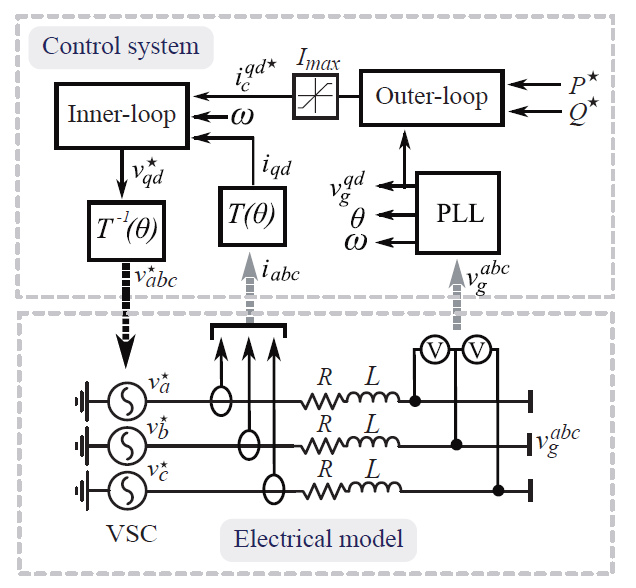
Most converter-connected wind, solar and battery resources operate in grid-following mode. A grid-following converter measures the voltage at its connection point and uses a phase-locked loop or a similar synchronization method to estimate the grid’s phase and frequency. Its controller then calculates the active and reactive current to inject relative to that measured reference. The converter therefore behaves primarily as a controlled current source: it can regulate power and support voltage within its operating limits, but it normally assumes that another device is already maintaining a sufficiently stable voltage waveform. As the network becomes weaker, the converter’s injected current has a greater influence on the voltage used by its own synchronization system, increasing the risk of control interactions, oscillations and loss of stable operation.
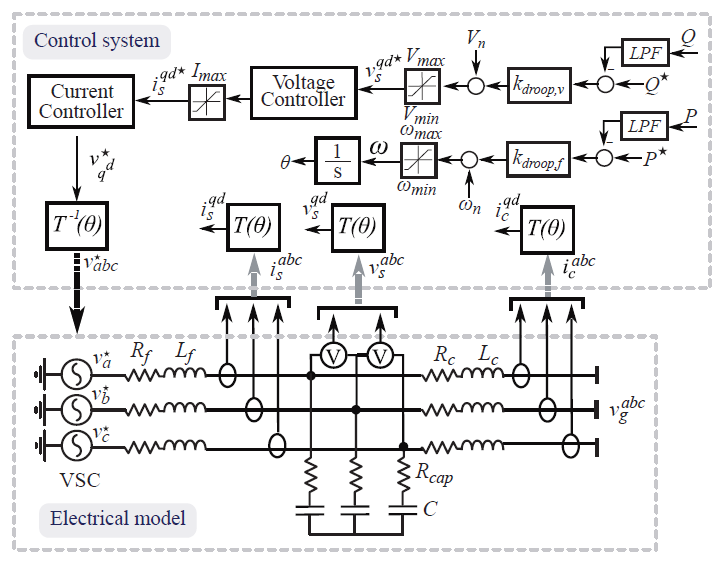
Grid-forming converters address this limitation by controlling an internal voltage magnitude and angle and exchanging power with the network through a physical or controlled impedance. They therefore contribute to establishing the voltage reference that grid-following equipment needs, replacing some of the stabilizing behaviour lost when synchronous generation is retired.
Grid-forming technology has now crossed an important threshold. It is no longer confined to academic studies or isolated demonstrations. Grid-forming battery projects are operating in Great Britain and Australia, manufacturers offer the capability on an increasing number of converter platforms, and system operators are beginning to introduce formal requirements and markets for the stability services these assets can provide.
Yet deployment remains concentrated in a relatively small number of projects supported by dedicated tenders, public funding or particularly demanding connection conditions. Across much of the market, developers continue to procure conventional grid-following equipment even when a grid-forming option is available.
The question is therefore no longer simply whether grid-forming technology works. It is what prevents a demonstrated capability from becoming a standardized, warrantable and financeable part of new converter-connected projects.
Grid-forming converters are likely to play a significant role in replacing the capabilities lost as synchronous generation retires. Scaling their deployment will require stable technical requirements, repeatable qualification processes and commercial arrangements that give manufacturers and developers a bankable reason to provide and operate the capability.
Commercial deployment has begun
Battery energy storage has become the leading large-scale application because it combines a controllable voltage-source converter with rapid bidirectional access to energy. Projects in Great Britain and Australia now provide practical evidence that grid-forming batteries can operate at utility scale and deliver measurable system value.
Blackhillock in Scotland is one of the clearest examples. The first phase of the project entered commercial operation in 2025 as part of Great Britain's first regional deployment of multiple grid-forming batteries. It was procured through the second Stability Pathfinder, under which the National Energy System Operator awarded ten long-term contracts worth £323 million. Five grid-forming batteries and five synchronous condensers were selected to secure 11.55 GVA of short-circuit level in Scotland and 6.75 GVA seconds of inertia across Great Britain. NESO estimates that the portfolio will produce approximately £500 million in savings over the ten-year contract period. The programme has since evolved into enduring Stability Markets, giving providers a route to compete for future stability needs rather than relying only on one-off demonstration tenders.
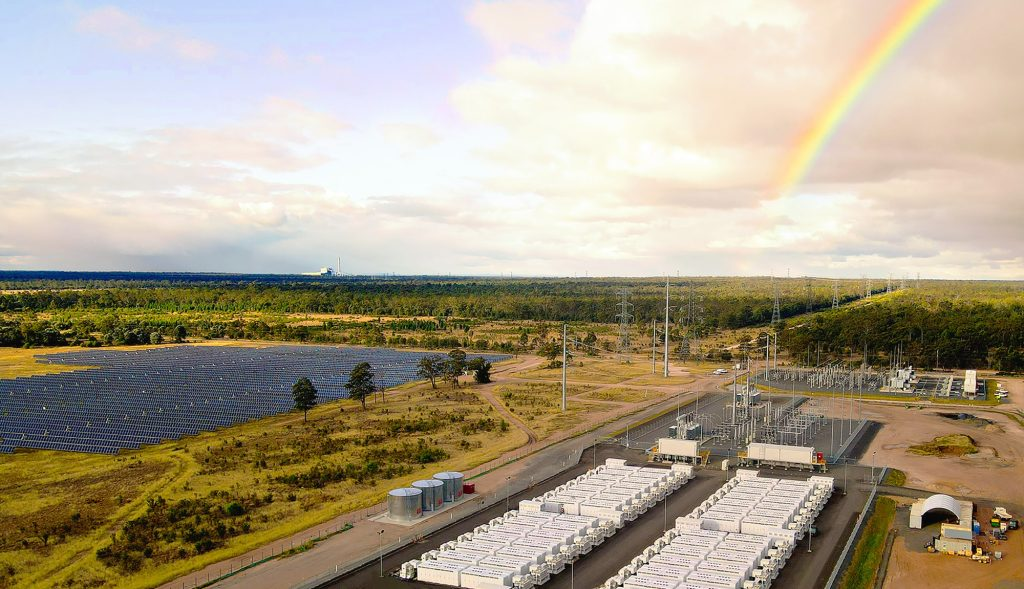
Australia has followed a different path. ARENA committed $176 million to eight large battery projects to reduce the technical, connection and financing risks associated with advanced inverters. The programme built on earlier operational experience at Hornsdale, Wallgrove, Dalrymple and other sites. Western Downs, originally commissioned in grid-following mode, was upgraded to grid-forming operation in March 2025 and later expanded to 540 MW / 1,080 MWh. ARENA's 2025 portfolio review shows that grid-forming BESS is moving beyond pilot scale while also documenting the additional modelling, coordination and commissioning work these projects require.
Grid forming is a control capability rather than a generation technology and can be expanded to many other generators. VSC-HVDC converters can form the voltage of offshore networks, weak receiving systems and restoration corridors. Full-converter wind and solar plants can also implement grid-forming controls, although their active-power response depends on available headroom, rotor or DC-link energy, storage and prevailing resource conditions. A STATCOM can provide valuable voltage-forming behaviour, but its ability to exchange active energy is limited unless it is combined with batteries, supercapacitors or another energy source. Even flexible loads such as EV chargers or heating systems are being explored for grid forming suitability. In general, energy availability is the key limiting factor to grid forming capability, as the capability is only valuable if the asset can sustain it during the disturbances and operating conditions for which the system is relying on it.
Ready for deployment does not mean technically uniform
The evidence from BESS projects justifies saying that grid-forming technology is commercially deployable. It does not justify treating every application and performance level as equally mature.
Operation in normal conditions and weak networks is relatively well understood for modern battery platforms. More difficult questions arise when a converter reaches its current limit during a severe fault or phase jump. At that point, the control must protect the semiconductor while preserving useful voltage-forming behaviour. The resulting response varies between products and can affect nearby converters, protection systems and post-fault recovery.
The industry is also still learning how multiple grid-forming and grid-following devices from different vendors interact in the same electrical area. A converter may satisfy a test against an ideal network and still respond poorly to a network resonance, another vendor's controller or an unexpected protection action. Black-box models protect intellectual property, but they can make independent validation and root-cause analysis more difficult.
Australia provides a useful illustration of this remaining gap. AEMO had already published a voluntary, performance-based specification and a test framework, but in 2025 it was still developing formal grid-forming access standards. It also launched further work because GFM inverters were effectively excluded from contributing to minimum system-strength requirements under the existing framework, particularly because their fault-current contribution was not yet adequately recognized. AEMO's access-standards review shows that proven hardware can still be held back by the way system services are defined and measured.
Grid forming has therefore moved beyond the question of basic feasibility. The current challenge is turning demonstrated behaviour into a repeatable product that can be specified, tested, certified, financed and operated across different networks.
Manufacturers need repeatable products
An OEM can develop a grid-forming algorithm once, but it cannot validate and warrant it efficiently if every system operator describes the capability differently. Requirements continue to vary in terminology, test conditions, fault duration, current priority, model format and the additional services expected from the same control mode.
This variation raises both engineering cost and liability. A manufacturer may be asked to guarantee plant behaviour that depends partly on the network model, plant controller, protection settings and equipment supplied by other parties. Bespoke studies can manage that risk on individual flagship projects, but they do not create the repeatable product and certification pathway required for a mass market.
Europe is moving toward a common technical language. ENTSO-E's November 2025 Phase II report defines grid-forming performance at the connection point and addresses the converter's behaviour at current limits, its synthetic-inertia response and the energy constraints of the underlying resource. However, the report remains non-binding guidance intended to support the future implementation of the revised Requirements for Generators network code.
The scalable route is a performance-based specification accompanied by reusable product qualification. A converter platform should be tested once across a defined operating envelope, using validated models and standardized disturbance cases. Project studies can then concentrate on the actual network, plant layout and interactions at the connection point. This would preserve competition between control architectures while reducing repeated engineering and giving developers greater certainty before equipment procurement.
Developers need a bankable reason to select and operate it
For a project developer, grid-forming capability can add cost well beyond the inverter functionality. The converter may require additional rating, while the connection process may demand detailed EMT models, control replicas, hardware-in-the-loop testing and a longer commissioning programme. The developer also assumes schedule and performance risk while the system operator, manufacturer and network owner establish how a relatively new requirement should be demonstrated.
The operating cost can be equally important. A battery may need to preserve state of charge or active-power headroom. A renewable plant may have to curtail its output to guarantee upward response. During a disturbance, current used for voltage support may reduce the active power the asset can deliver into the energy or ancillary-service markets. Recovery after an event can create additional energy use and battery degradation.
If these obligations are introduced late through a project-specific connection agreement, the developer carries a system-wide cost that competing or previously connected assets may avoid. The capability can be valuable to the system while remaining unattractive to the party expected to finance and operate it.
Public support in Australia and long-term stability contracts in Great Britain have helped close that gap. Their success strengthens the central commercial argument: deployment accelerates when the technical requirement is accompanied by a credible route to recover the incremental cost and risk.
Minimum capability and additional services should be separated
Not every aspect of grid-forming performance requires its own market product. Where a defined level of voltage-forming behaviour is necessary for the secure connection of a new plant, system operators can include a consistent minimum requirement in the grid code. Applying that requirement predictably across comparable new assets creates a level procurement basis and allows developers to reflect the cost in their investment decisions.
Higher performance creates a different commercial question. An asset that must reserve current, energy or state of charge, remain available in a particular location, withstand more onerous disturbances or support islanding and restoration accepts an ongoing operational obligation. Those capabilities should be procured where the system needs them and compensated through financeable contracts.
Great Britain's emerging model illustrates this distinction. The Grid Code establishes minimum rules for grid-forming connections, while participation in the Stability Markets can require higher performance in exchange for payment. This is more scalable than treating grid forming as a single label that automatically includes every possible stability and restoration service.
The same distinction would improve technology neutrality. A system operator should procure an observable outcome at a defined location and operating point. Grid-forming BESS, synchronous condensers, STATCOMS, and other technologies can then compete where they are capable of meeting the requirement. The procurement decision can account for the different combinations of voltage support, inertia, fault response, energy availability and restoration performance offered by each solution without assuming that one technology must provide everything.
The value must be identified geographically
Grid-forming capability can reduce the need to commit synchronous generation purely for stability and can allow more converter-connected generation to operate securely in weak areas. Depending on the location, it may also defer network investment, reduce stability-related redispatch, improve resilience and support faster restoration.
These benefits are distributed across the system. The system operator may avoid reinforcement or redispatch costs, nearby renewable projects may experience fewer operating restrictions, and consumers may benefit from a more secure and lower-carbon network. The project providing the capability cannot automatically capture those avoided costs.
This is the remaining market-design problem. The total system value can exceed the incremental project cost while the developer's private revenue remains below the cost and risk of providing the service.
System operators can make that value actionable by publishing regional stability needs before developers select equipment. A useful roadmap would identify the electrical areas affected by synchronous-plant retirement, the expected timing and volume of the requirement, the disturbances against which performance will be assessed and the acceptable technology alternatives. Procurement can then target the locations where the capability avoids the greatest system cost.
Long-term visibility is equally important for the supply chain. Manufacturers will invest in standardized products and certification when they can see repeatable demand. Developers can incorporate the required converter rating, energy margin and testing programme into the original project design when the rules are known before equipment selection. Late requirements produce bespoke engineering, commercial claims and avoidable connection delays.
The market is beginning to switch the capability on
Grid-forming technology is no longer waiting for its first commercial proof. Batteries are operating at utility scale, and HVDC, renewable generation and advanced reactive-compensation systems can also contribute when their hardware and energy limitations are properly recognized.
The remaining transition is from successful projects to a repeatable market. That requires a common definition of minimum performance, qualification that can be reused across projects, local studies focused on genuine network interactions and commercial arrangements that compensate obligations extending beyond the minimum connection standard.
Power systems will not need every converter to form the grid. They will need enough capable equipment, connected in the right electrical locations and available during the operating conditions that matter. Determining that mix is a system-planning task, while delivering it requires a credible investment proposition for manufacturers and developers.
The power system already recognizes the operational value of grid formation. Great Britain and Australia show that deployment follows when this value is translated into clear requirements, funded demonstrations or long-term procurement. The next step is to make those pathways predictable enough that grid-forming capability becomes a standard project decision rather than an exceptional experiment.
How eRoots can help
At eRoots, we help manufacturers, developers and asset owners navigate the path from control concept to bankable grid connection. We support grid-forming control and model development, RMS and EMT studies, multi-vendor interaction analysis, grid-code interpretation, compliance testing and the translation of emerging technical requirements into practical project specifications.
If you are developing a grid-forming product, specifying a new BESS or renewable project, or assessing how an asset will perform in a converter-dominated network, we would be happy to discuss the technical and commercial path to deployment.